


- A Japanese tea set is made of earthenware, ceramic or stoneware, in dark, textured tones.
- Three classic teapots: the kyusu (side handle), the dobin and the cast iron tetsubin.
- The accessories: handleless yunomi cups, chataku coasters, measuring spoon.
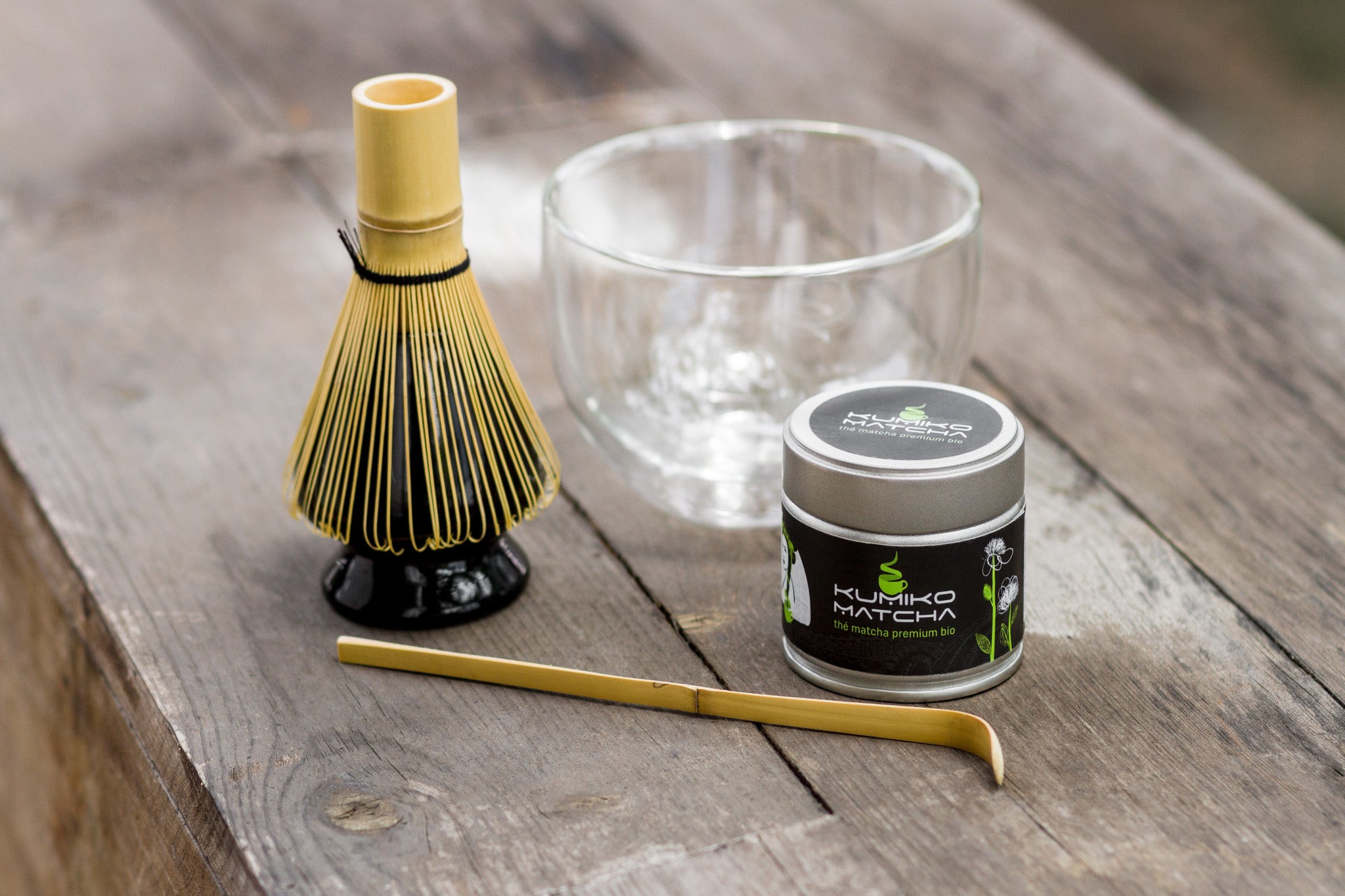
- For matcha: chawan bowl, chasen bamboo whisk and chashaku scoop.
- Being well equipped transforms the tea preparation and tasting experience.


 You want to prepare Japanese tea at home, but you don't know which utensils to buy to make tea the traditional way?
You should know that preparing Japanese green tea is very different from preparing the black tea we're used to drinking in the West; therefore, there are several points to know in order to build a set suited to your personal tasting preferences.
That's why today I invite you to discover the different utensils used to prepare Japanese green tea, so you can create your very own tea set!

What is a Japanese tea set?
In the West, we're more familiar with English-style tea sets, intended for preparing black tea: white, uniform and made of porcelain, often accompanied by milk and sugar pots.
But what distinguishes the tea set we know well from the Japanese tea set?
First of all, Japanese tea sets are generally made from earthenware, ceramic or stoneware. Porcelain, on the other hand, is rather reserved for certain objects only, like saucers. It's also noticeable that the pottery comes in darker colors (often in grey or brown shades), and features texture effects and patterns, rather than a uniform finish.
For the Japanese, it isn't necessary for the teapot, cups and all the utensils to have the same aesthetic like a matching set. It's even good form to offer a unique cup to each guest, so that everyone feels treated with the respect they deserve.
Teapots for preparing Japanese tea
Among the tools used to prepare Japanese tea, we first find the different teapots that exist.
- The most common teapot is called the kyusu. Rather small (with an average capacity of 300ml), it is often made from terracotta. It's easily identifiable by its side handle. It's a very practical teapot because it very often has a built-in filter, which allows you to pour the tea down to the last drop, without finding leaves in your cup!
- The second type of teapot common in Japan is the dobin. It's a larger teapot than the kyusu with bamboo or wicker handles, used when you have more guests.
- Finally, the last common type of teapot is the tetsubin. This cast iron teapot was created based on Asian water kettles under Western influence. Very durable, it's a precious object that can be kept for a lifetime. Ideal for preparing teas with larger leaves like bancha.
Japanese tea accessories
Once the teapot is chosen, we can focus on 3 other main types of accessories:
- Cups: handleless, Japanese tea cups have a capacity of about 120ml. This capacity is suited to preparing Japanese green tea, which is generally steeped in less water than black tea. The traditional cups with high sides are called yunomi.
- Coasters: called chataku, they are smaller in size than in the West. They are traditionally made from lacquered wood, or very high quality porcelain. Coasters add a significant visual dimension to the multisensory experience that is tasting a good tea, so they shouldn't be overlooked.
- The measuring spoon: called sami, it's a spoon, often made from fine woods such as peach, cherry or camphor, allowing you to measure the tea and observe its volume. It generally holds between 2 and 5g.
With all these traditional utensils, it's possible to recreate the experience of preparing a delicious green tea, using traditional Japanese methods.


Garantie qualité 30 jours
Nous sommes tellement convaincus que vous allez aimer le Matcha KUMIKO que nous offrons une Garantie satisfait ou remboursé de 30 jours. Retournez simplement votre boîte non ouverte sous 30 jours pour un remboursement intégral.
Les accessoires indispensables
Parcourez notre sélection et trouvez ce qu'il vous faut.

Quiz · 60 sec
Quel matériel pour votre matcha ?
4 questions, 60 secondes — testé et validé par 3000+ buveurs.
Commencer le quizz

Quiz · 60 sec
Quel matériel pour votre matcha ?
4 questions, 60 secondes — testé et validé par 3000+ buveurs.
Commencer le quizzThe utensils for preparing matcha tea

Another type of tea set is essential to have in your collection in order to prepare all Japanese teas: a matcha set!
Yes indeed, matcha being a powdered tea, traditionally prepared during the Japanese tea ceremony Chanoyu, its preparation requires specific utensils.
Among them, we mainly find:
- the chawan, or matcha bowl. It's a bowl whose sides are generally high and the bottom flat, in order to whisk the matcha tea more easily, and to retain its heat.
- the chasen, or bamboo whisk. The whisk mixes the hot water with the tea powder to create an emulsion, responsible for the formation of a fine layer of foam on the surface of the tea. The chasen has on average 80 to 100 bristles, and can be golden or brown in color.
- the chashaku, or bamboo scoop. This long, thin scoop allows you to precisely measure the amount of powder you pour into the matcha bowl. To prepare a bowl of light matcha, count 2 heaped scoops, and 3 scoops for a strong matcha.
To complete this matcha set, it's common to add a naoshi, a stand for the bamboo whisk. As well as being aesthetically pleasing, it extends the life of the precious chasen. You can also perfect the set with a natsume, a box used to hold the matcha. Traditionally lacquered and adorned with traditional golden patterns, it's truly a work of art.
Now that you know the utensils needed to prepare Japanese tea, I invite you to discover the matcha utensils I offer to my community. Made by passionate artisans and crafted by hand, they will accompany you during your organic matcha tastings.

>>> Click here to discover all the accessories
=> Right now, get a 10% discount on your first organic Matcha purchase with the code KUMIKO10!


