


- Matcha and wine share a common logic: grape varieties for one, cultivars for the other.
- The best matcha, like great wines, can come from a single cultivar (single-cultivar).
- Both are classified by grades (5 for matcha, from culinary to ultra-premium).
- The "ceremonial" label, unregulated for export, gives consumers little useful guidance.
- Tea sommellerie exists too: describing, pairing, and appreciating matcha.


While wine is a true national symbol in France, matcha lies at the heart of the Japanese tea ceremony, a ritual elevated to a genuine art form in Japan.
Two exceptional products, quite different from each other, yet with far more in common than you might think.
So why are they sometimes compared? Let us explain!
Grape varieties for wine, cultivars for matcha

To describe a wine and give a sense of its aromatic profile, it's very common to refer to its grape variety or varieties.
What is a grape variety?
A grape variety is a group of similar vines descended from the same seed. It is a grapevine variety with a particular genome, giving it a distinctive, recognizable shape, color, and aromatic profile. There are an estimated 6,000 grape varieties in the world today.
At any wine shop, you can easily find bottles made from Pinot Noir, Cabernet Sauvignon, Chardonnay, or Aligoté grapes, for example.
What is a cultivar?
In the same way, tea—and matcha in particular—has its own equivalent of the grape variety: the cultivar. A cultivar is a set of tea plants "cloned" through cuttings, obtained by taking a branch from a parent tea plant. Thanks to this method, you get identical tea plants with a precise aromatic profile, allowing for a uniform harvest.
Commercially, average matcha often comes from a blend, with no way to trace the original cultivar. However, the most prestigious matcha can be made from a single cultivar, known as single-cultivar.
Among the most popular cultivars for producing green tea, you'll find for example:
- the Yabukita cultivar, the most popular in Japan
- the Saemidori cultivar
- the Okumidori cultivar
- the Samidori cultivar
Matcha can also be vintage-dated, but unlike wine, it loses its freshness over time, so it's rare to find matcha more than two years old on sale.

Wine and matcha are both classified by grade
Another interesting point of comparison: both wine and matcha are classified according to a grading system.
For wine, there are 4 grades: Appellation d'Origine Contrôlée (AOC), Appellation d'Origine Vin de Qualité Supérieure (AOVDQS), Vin de Pays, and Vin de Table.
For matcha, there are 5 main grades:
- Grade A, or culinary grade, often found in supermarkets
- Grade AA, or "blending" or "café" grade
- Grade AAA, or "premium" grade
- Grade AAAA, or "ceremonial" grade
- Grade AAAAA, or "prestige" or "ultra-premium" grade
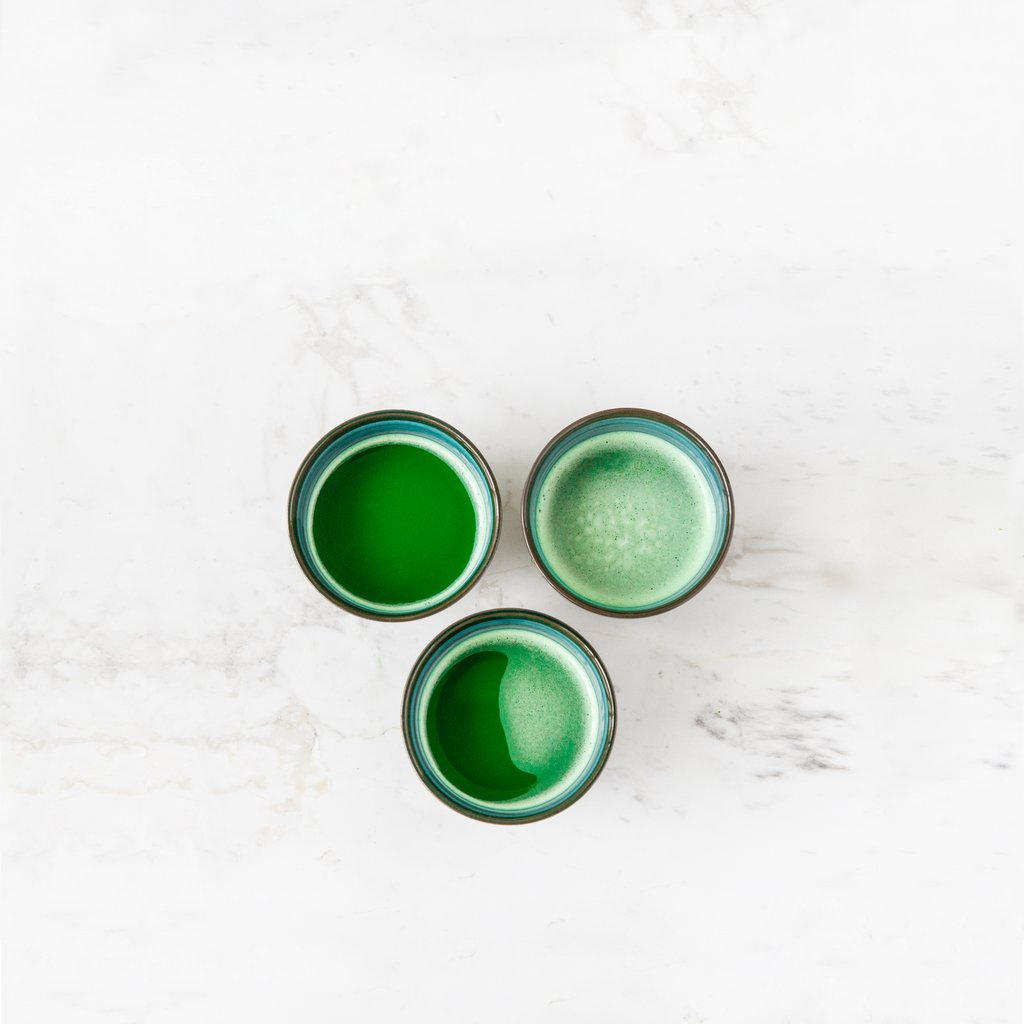
Comparing a selection of teas across several grades up close reveals major differences in the quality of the powder, whether in its color or its fineness.
However, unlike France's strictly regulated wine appellations, the "ceremonial matcha" label is not regulated for export. That's why we prefer not to use it, as we believe it doesn't provide meaningful information to help consumers make the right choice when buying matcha.
Pour aller plus loin : What Does Matcha Tea Taste Like? →
Trouvez votre matcha idéal 🍵
Parcourez notre sélection et trouvez ce qu'il vous faut.
Sommellerie exists in wine... and in tea
You've surely heard of wine sommellerie, a quintessentially French art.
A wine sommelier is a highly trained specialist able to identify the grape variety, vintage, or origin of a particular wine, and to create harmonious food and wine pairings. These professionals often work in grand hotels and upscale restaurants, with the goal of guaranteeing their guests a truly successful tasting experience.
In recent years, however, we've gradually discovered that tea is just as interesting to pair with dishes—a kind of sober little sibling of wine. That's why tea sommellerie, driven by passionate enthusiasts, is growing steadily and aiming to professionalize. Just like a wine sommelier, a tea sommelier can distinguish between the different types of tea, describe a tea's aromatic profile, and pair it with a menu.
Tea, and matcha in particular, is becoming increasingly popular in cooking and baking for all its health benefits.
There's no doubt about it—these two drinks put a whole world of creativity within our reach!
>>> Discover a tea sommelier's tasting tips for our matcha by clicking here


