



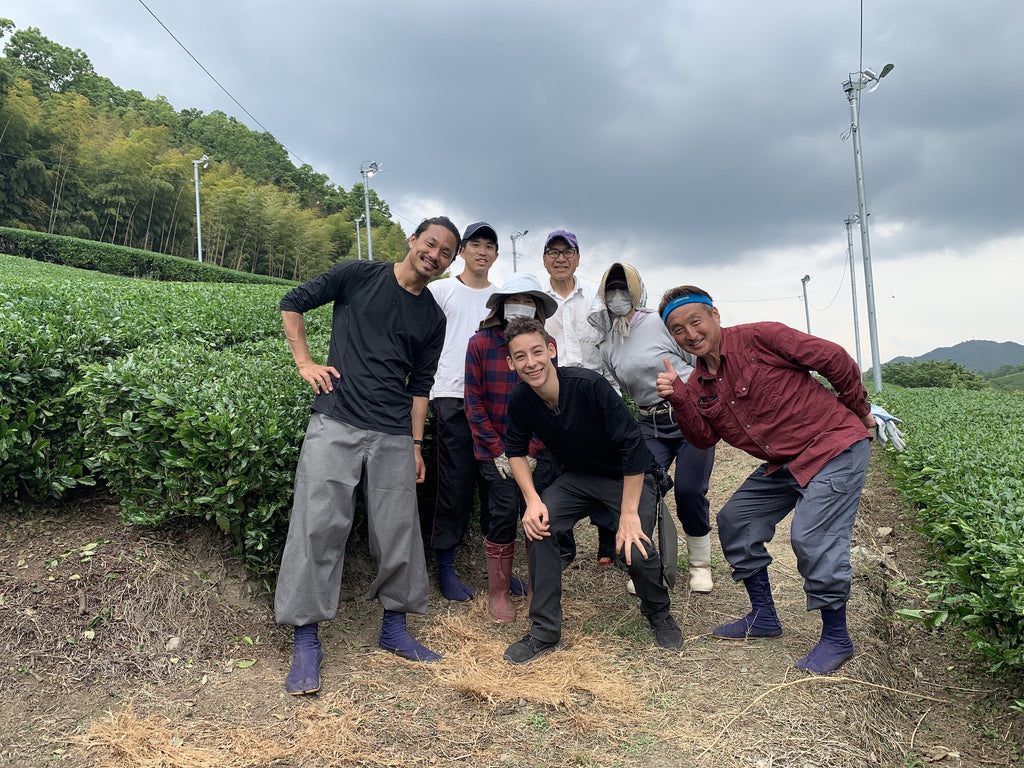
Tokuya-san is the farmer who produces our natural Tokuya-san 2018 matcha tea in the village of Wazuka, near Kyoto.
If you are interested in other profiles of our partner farmers, view the stories of Takeshi-san and Nishi-san.
In short
- Their matcha tea is completely natural.
- Its tea is a unique, native cultivar.
- Tokuya-san's natural matcha tea is comparable to natural wine. It is more artisanal, more tannic, with more character.
Let's view it more closely...
The story of Tokuya-san
Click on the play button to start the video (10 min 55 sec) - May 2019
In Tokuya-san's family, tea has been produced for generations. From his teenage years, he spent a lot of time in the tea fields helping his father during the harvest season.
Unfortunately, the fertilizers and pesticides his father uses make him sick and weak.
He had a revelation in 2013, when his son Tokuto was born. His father gave him part of the family land, and Tokuya-san began growing tea without using fertilizers or pesticides.
At first, the transition is difficult: insects and diseases multiply. He realizes that he must first stop using chemical fertilizers for two years before stopping pesticides.
Why doesn't Tokuya-san's tea have organic certification?

Even though the tea offered by Tokuya-san is grown naturally, without any inputs/fertilizers/pesticides, it does not have organic certification.
He says he hasn't needed it until now, as he sold his tea to acquaintances who know about his commitment and history, but he is considering obtaining it so that he can share his tea with more people around the world.
A particular cultivar
Click on the play button to start the video (1 min 36 sec) - May 2018
The zairai (native) cultivar is a plant that was planted and then Reproduced naturally : that is, the flowering and fertilization of the flowers is done with the help of pollinating insects such as bees, then the seed grows to form a new plant.
This method of tea cultivation is extremely rare today—it accounts for only 3% of teas grown in Japan!
In fact, most teas consumed today are cloned (by cuttings, etc.) to obtain a uniform and consistent taste. Such as Yabukita or Saemidori.
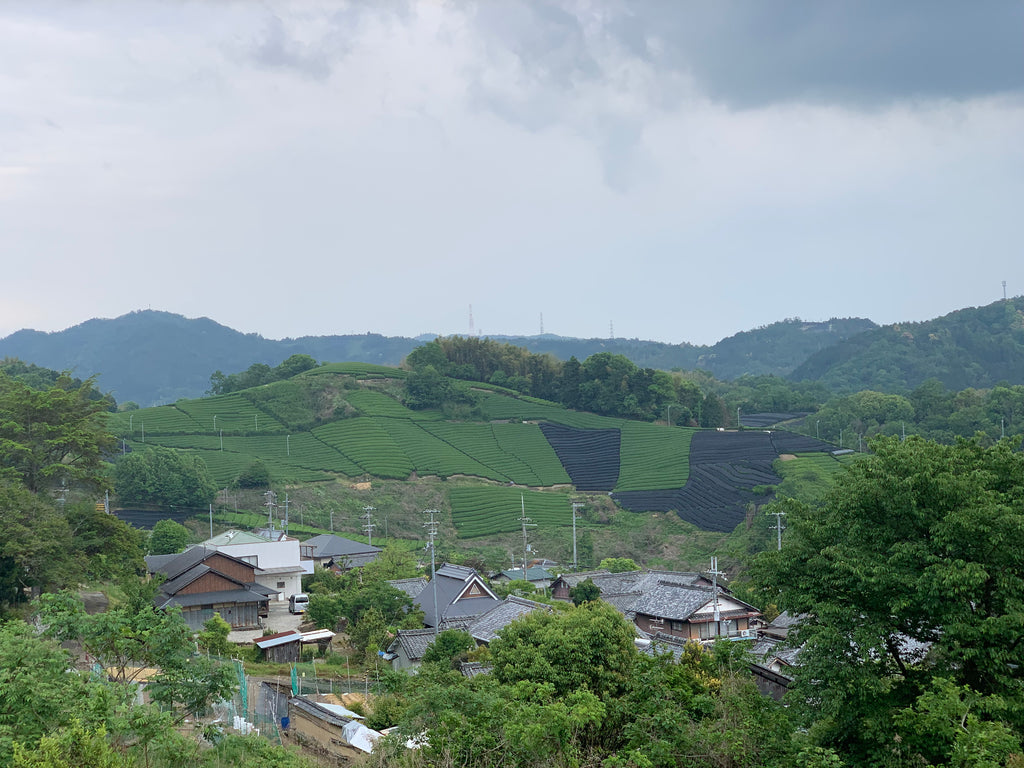
Tokuya-san's tea fields
Zairai cultivars are robust, resistant to both cold weather and insects, and have a distinctive, less sweet taste.
For Tokuya-san, it is important to listen to nature and let the tea grow on its own. In fact, he says that it is tea that teaches him to be a better farmer and to improve year after year.
Thus, Tokuya-san's tea changes from year to year. The 2018 vintage is different from the previous year's tea, and the 2019 harvest promises yet another different taste. This year's production has a slight bitterness immediately followed by a sweetness.
Tokuya-san's fields
Click on the play button to start the video (2 min 22 sec) - May 2019
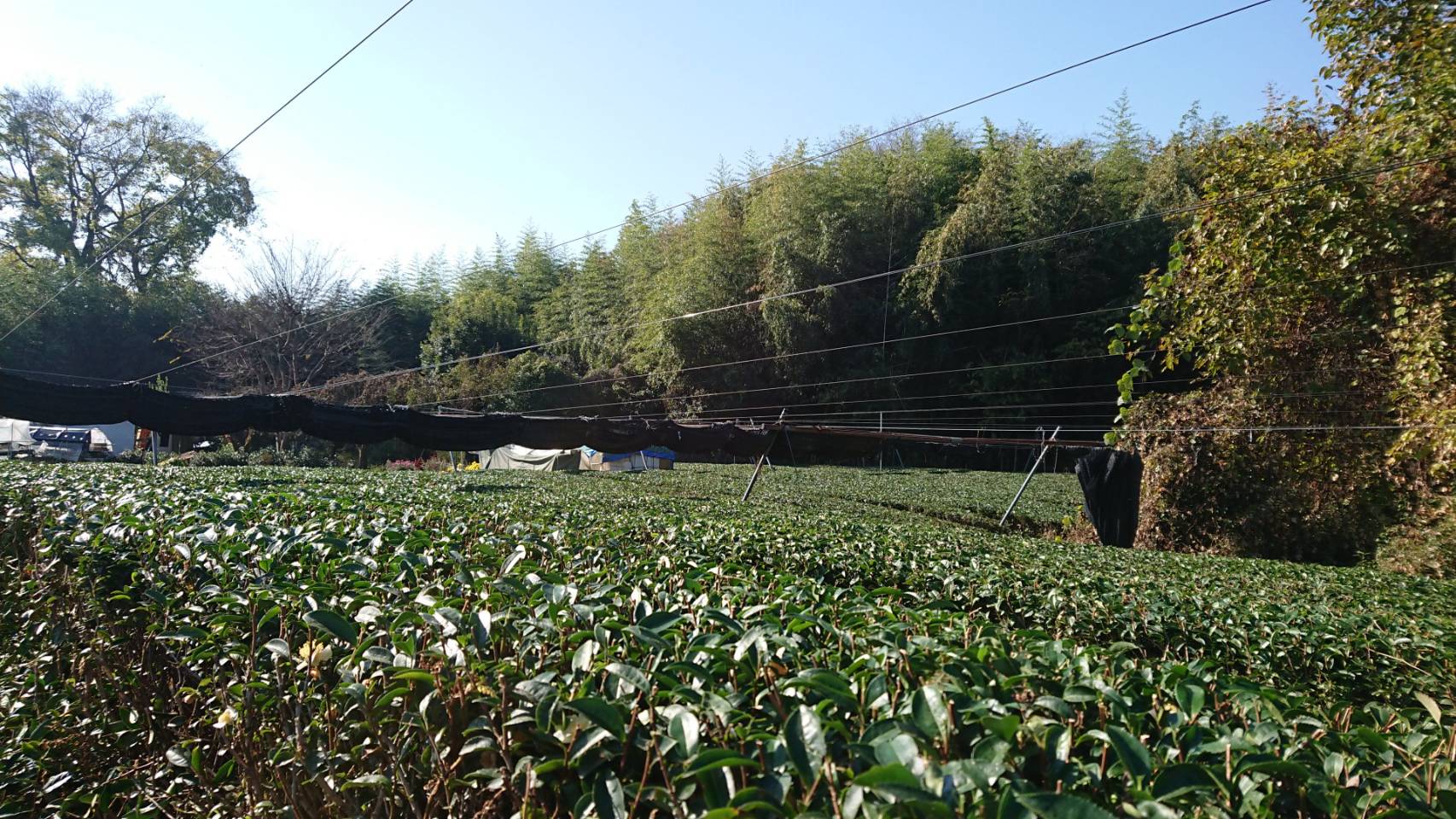
The plants are shaded more than usual to help air circulate more easily between them.
Additional areas can also be added to make the environment more shaded if necessary.
Next to Tokuya-san's field, you can find wild tea plants that have grown quite tall. The leaves are too thick to make tea, but Tokuya-san's family picks them to make tempura (Japanese fritters).
Tokuya-san told me about another experiment he launched in the fall of 2019 that will further reduce the quantities he produces in favor of quality.
I'm telling you this story so you can view Tokuya-san as a special and amazing farmer.
So he decided to prune the sides of his natural tea plants:

He is experimenting with this for three reasons:
- This will make the central "trunk" of the tea plant stronger as it will grow thicker.
- Air circulation is improved between the branches,
- The sun can reach much further into the ground between the rows of tea plants, which encourages the growth of grasses, or what some might call "weeds." Tokuya-san explains that this enriches and strengthens the soil and improves its quality.
The only "drawback" is that pruning the sides of the plants reduces the yield of its harvests and therefore it will produce even less quantity (its natural zairai tea plantation is already limited), in favor of superior quality and originality.
According to him, it's a pursuit that interests and motivates him, which is why he does it. I love it! That's the kind of thing that separates a good quality matcha from an original, excellent quality matcha: Tokuya-san's vision, originality, and passion.
I invite you to continue reading this page to discover now the unique characteristics of its Zairai cultivar tea and learn more about its history and philosophy in this video!
The May harvest
Click on the play button to start the video (6 min 53 sec) - May 2019
This is a special time of year when farmers are very busy. They don't have a minute to lose because the freshly harvested tea leaves must be processed before they oxidize. They spend their days in the fields picking leaves and their nights in the factory steaming them and transforming them into aracha (rough tea).
Tencha (碾茶) is produced from aracha by removing the stems and impurities. This tencha is then ground to produce matcha (抹茶).
At Tokuya-san, harvesting is done with the help of a semi-manual machine that is usually operated by three people.
In the tea factory with Tokuya-san
Click on the play button to start the video (5 min 25 sec) - May 2019
In this video, we are at the cooperative factory that is in the process of producing kabusecha (かぶせ茶), or shaded tea.
The steps are quite similar to those for producing matcha. I recommend watching this very comprehensive video that I filmed at the Nishi-san factory, specifically for organic matcha.
In the video above, I talk about several types of green tea: sencha, gyokuro, and kabusecha.
Do you know the difference between these three teas?
- Sencha (煎茶) is the most common of the three teas. It is not shaded and is rolled into a needle shape. It has a rather astringent and refreshing taste.
- Gyokuro (玉露) is covered for about twenty days before harvest. It has a smoother taste and more umami. It was highly prized by the Japanese nobility.
- Kabusecha (かぶせ茶) is also covered, but for a shorter period of about a week. It combines the features of sencha and gyokuro.
Tencha, on the other hand, is covered for about three weeks. This is what gives it its smooth, sweet taste.
Tokuya-san's matcha tea
This is Tokuya-san's natural matcha tea. It is an artisanal matcha, tannic, with a lot of character. I am very proud to work with Tokuya-san to offer you this quality of matcha, which is entirely natural and as close as possible to what it was in the days of the samurai.
I spent a lot of time with Tokuya-san and he shared a lot of knowledge with me, which you can learn more about on his page, including his letter about the price.
If you try her natural matcha tea, please leave a comment about your experience, as I will be visiting her next year and will share the community's feedback with her.
Thank you for reading this item!
Let me know if I can help you or if you have any questions—I'll take good care of you.
- Val de Kumiko Matcha


