



In addition to a beautiful matcha bowl, using a bamboo whisk is essential for successfully preparing matcha and enjoying the best possible taste experience.
That's why today I'm showing you the difference between a "conventional" bamboo whisk made in China and a handcrafted piece by Hirata-san, our artisan partner in Japan.
I invite you to watch my video comparing these two matcha whisks:
Bamboo matcha whisks in Japan
During my first trips to Japan, I was looking to buy locally made, artisanal bamboo whisks or bamboo matcha whisks.
It was then that I noticed that many tea shops in Japan did not offer handmade whisks and preferred to sell cheaper accessories made in China. These Chinese products are sometimes found in the West, in large retail chains such as Carrefour or Leclerc. These whisks are sold with their tin of matcha tea and are far from the quality of handmade whisks.
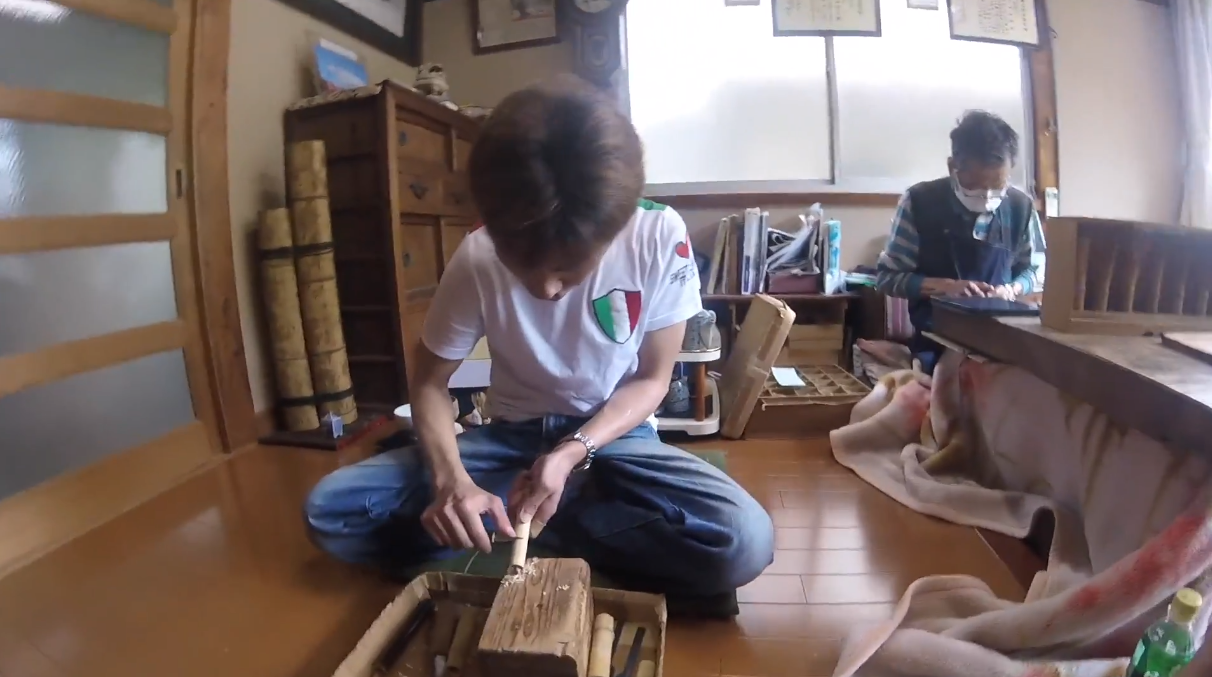
After extensive searching, I finally found a Japanese artisan who made bamboo whisks by hand: Hirata-san. He invited me to his home, to his family workshop, which is also the living room of the house he shares with his parents.
Hirata-san's warm personality and dedication to his labour touched me deeply, so I decided to offer his creations to the Kumiko Matcha community.
The special features of an artisan bamboo matcha whisk

Hirata-san is a young artisan who makes all his bamboo whisks, also known as chasen, with his father, following methods passed down from generation to generation.
According to him, the taste and creaminess of matcha depend directly on the quality of the whisk used.
What makes a good bamboo matcha whisk is its shinari. This is its flexibility, the elasticity of each of its strands. It is thanks to shinari that we can form a froth by whisking the tea with a chasen.
Each piece of bamboo reacts differently, some are more tender, and others more rigid. A machine is unable to adapt to these almost imperceptible differences, unlike an experienced artisan.
By finding the perfect balance for each strand—neither too stiff nor too flexible—the bamboo whisk will produce a frothy, light, and smooth tea.
The technique and expertise of artisans such as Hirata-san are invaluable! And I am so happy to be involved in spreading his matcha art to the Kumiko Matcha community.
If you would like to order Hirata-san's handcrafted items, such as the bamboo whisk for matcha, here are the ones you can find in the shop today:
Conventional matcha whisk
"Conventional" bamboo chasen are produced in China using traditional Japanese methods. I decided to offer them to the Kumiko Matcha community to make matcha tea preparation as accessible and affordable as possible.
You can find more details about the conventional whisks I offer in the matcha whisk collection.
In summary, here are the qualities and flaws of each type of matcha whisk.
Conventional whisks
✅Pros
- Made in China, following traditional Japanese methods.
- Affordable and sufficient for beginners.
❌ Cons
- they produce a lower quality froth
- their appearance is less refined and artisanal
Hirata-san's artisan whisks
✅ Pros
- A fine and delicate object, created by an experienced artisan.
- creates a light, smooth froth
- A true cultural object, essential for practising the matcha ritual.
- An excellent investment that can be used for years when cared for properly.
❌ Cons
- The price is higher than a whisk made in China.
In conclusion, here are a few tips for taking care of your bamboo matcha whisk and keeping it in good condition for a long time.
Use and care of bamboo whisks

- Before use, pour a little warm water into a glass and dip the whisk in it to soften the bamboo strands.
- After each use, rinse the bamboo matcha whisk with water, making sure to clean off any remaining tea, and wipe it dry with a dry cloth.
- Use a whisk holder (naoshi), which will preserve the rounded shape of the whisk.
- Do not expose to drafts (wind, air conditioning) or temperature changes.
Thank you for reading this item! Please feel free to leave a comment on this page if you have any questions or comments!
Val de Kumiko Matcha
=> Now: Visit our matcha tea collection and enjoy free delivery on orders over €49..


