


click the play button to watch Yamashita-san's interview (2min17)
Yamashita-san discovered and learned pottery thanks to his father-in-law, a researcher at a ceramics research institute.
He has been perfecting his craft for more than 30 years.
When he makes his pottery, he empties his mind and focuses on his work. He says he thinks about nothing at all.
He loves seeing his creations used in everyday life, and he considers his pottery everyday objects. He does his utmost to keep his prices affordable with the sole aim of having his bowls used in our daily lives.
Although Yamashita-san's bowls are reasonably priced, they are all made by hand by himself, using the traditional clay and glaze of the region.
I was won over by his philosophy, and I am very proud that he is part of our partner artisans.

above, I am posing with Yamashita-san during our second meeting in May 2019
In this video, Yamashita-san shows us how he uses his fresh clay to shape a matcha bowl with his hands.
click the play button to watch the video (4min)
He then shows us in detail all the steps of the process, from clay to the finished bowl.
click the play button to watch the video (5min)
Yamashita-san makes the glaze for his pottery himself.
click the play button to watch the video (1min51)
For the final step, there are two ways to fire the glaze:

the kiln temperature is 1260ºC during the glaze firing
Karatsu is a port town located on the island of Kyushu, in the far south of Japan.
Thanks to its geographical location, it has been in contact with China and the Korean peninsula since ancient times. And it is thanks to this external influence that Karatsu was the first region in Japan to make bowls with a glossy glaze.
Karatsu pottery (唐津焼, karatsu-yaki) became famous throughout Japan in a very short time.
At the end of the 16th century, Karatsu matcha tea bowls were recognized by the great tea masters as one of the three predominant bowl styles, along with Raku pottery (楽焼, raku-yaki) and Hagi pottery (萩焼, hagi-yaki).
When I asked Yamashita-san whether he intended to pass his art on to his children, he told me no, because his clay deposit is exhausted.
He showed me this photo, telling me "I have enough to last until I retire, and after that it will be over":

As Yamashita-san explains to us, there is a large element of randomness in his creations.
When he fires the glaze of his bowls, for example, the result can vary depending on the bowl's position inside the kiln due to heat variations.
Of course, he also has no control over how the glaze flows.
It is a deliberate choice to keep this element of the unexpected, and for me, this is what truly makes Japanese pottery so charming. Not everything is standardized as in industrial production.
The slight irregularities of each bowl give them a different character and personality.
⚠️ Usage tips from Yamashita-san:
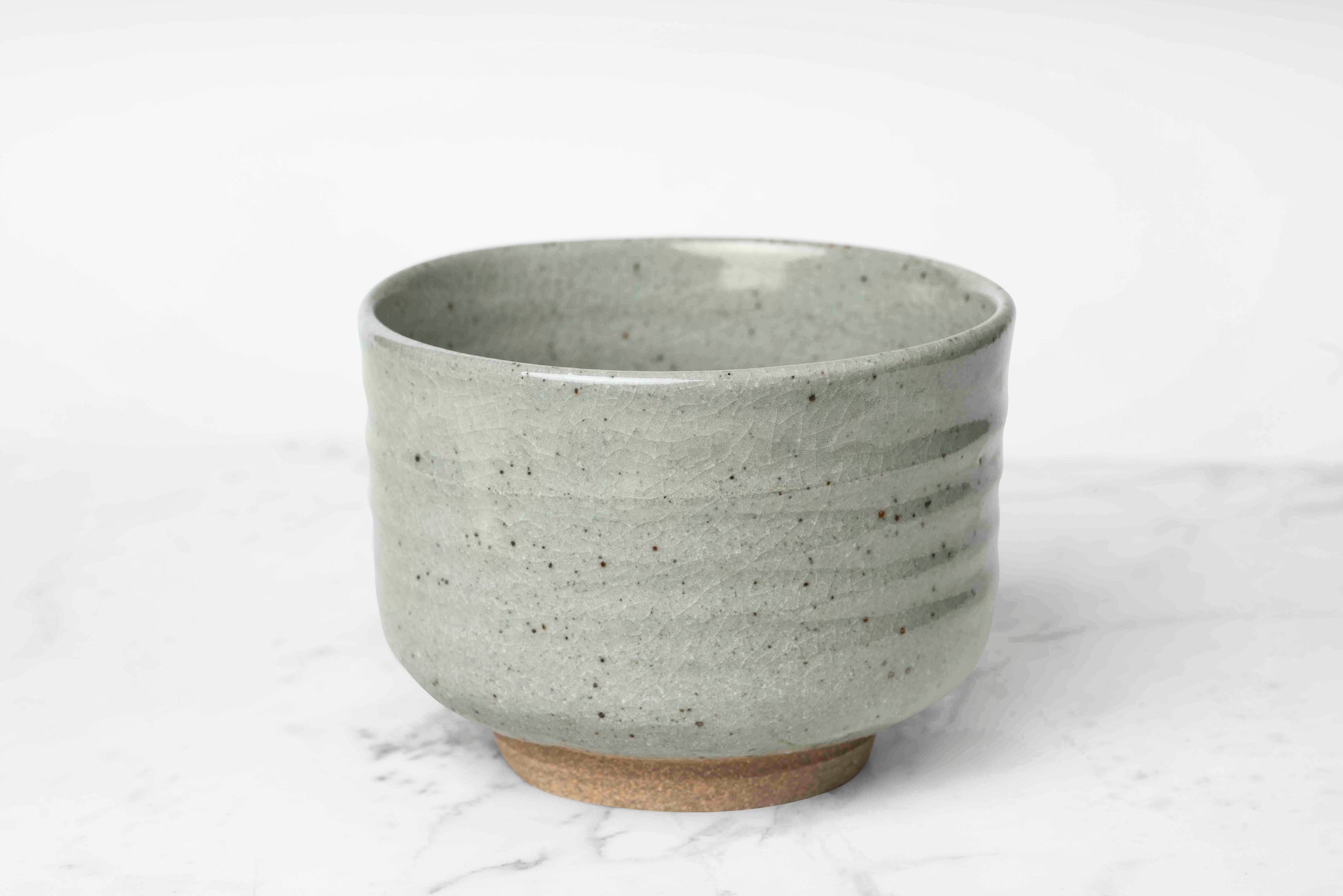
This bowl, gray with green reflections, with a glossy speckled glaze, is elegant and minimalist.
I love the details: the foot, which is not glazed, is rough and earth-colored.
My favorite little detail is the center of the bottom of the bowl: Yamashita-san drew a swirl shape, which collects the suspended matcha tea and offers a last sip that is slightly more concentrated and very pleasant.
I hope you will enjoy sipping your daily matcha from this Karatsu artisan bowl.
I am very happy and proud to present this bowl by Yamashita-san, which is very affordable for craftsmanship of this quality.
This is a new shape, with high sides, very practical for whisking your matcha. The colors differ slightly from one series to another, so if you like this bowl and want to make it yours, I recommend ordering it as we only have a few pieces of this series.
On behalf of Yamashita-san and myself, we wish you a wonderful tasting!
First of all, the material is different: while we use a mixture of earths (clay, marl, silica), most Japanese potters use only clay.
Since we hold the bowls in our hands to admire them before bringing them to our mouths to enjoy matcha tea, great attention is paid to the texture of the bowl and to how it transfers heat.
The other very different element is that in the West, we often use a set of identical cups, whereas in Japan it is common to have many different cups. Originally, in the tea ceremony, it is the host's responsibility to choose a selection of cups that go well together to please their guests.
Finally, the Japanese find beauty in the distortions and "accidental" irregularities of pottery and its glaze. Wear rounds the edges of the bowls and beautifies them. This is the concept of wabi-sabi.
During the preparation of matcha tea, leave most of the bowl empty to admire the color of the matcha and the reflections of the glaze. Take note of the texture and sheen of the matcha.
The bottom of the bowl is flat and its capacity is particularly suited to a preparation for 80-100mL.
Recently viewed


